This Week's Blog
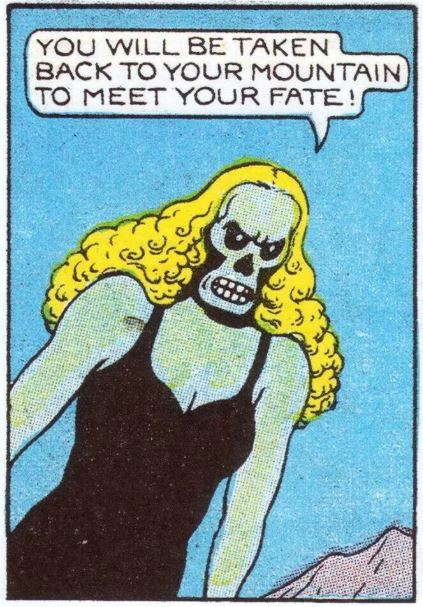
AI Art removed from Eisner Awards
And
He
died alone on a park bench...Which was the style at the time.
We got a full boat this week. We have the mess of AI art getting an
Eisner Nomination, we're gonna learn about how AI art programs actually function,
and about a
mysterious comic book legend who was so weird it didn't matter
how bad he was at comics. but first...
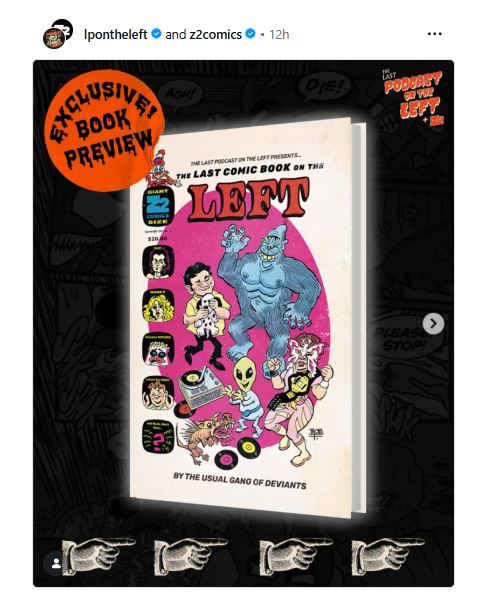
I am going to do something out of character and actually plug
something. The guys at The Last Podcast on the Left and Z2
Comics have made a collection of stories from "Last Comic Book
on the Left". Which includes a
full color Arsenic Lullaby tale of drama, romance, and action!
It is one of the best stories I've ever done. And I do mean
that.
NOW THEN...
The
Eisner Awards, for anyone who doesn't know, is a big prestigious award in the comic book industry.
This year they, apparently unknowingly, allowed some
A.I.
art to get a nomination. As
you can imagine the comic book world was not pleased.
It was a page of an anthology book titled "Stardust"
where various creators did pieces based on the work of the
legendary Fletcher Hanks.
I'm going to blow through the high points of this AI/Eisner
Award mess as fast
as I can, because it's a tale that you could probably guess
most of the why's and wherefores on your own AND because there's a
more interesting aspect to all this, than what happens with the
award.
To people on the outside looking in, the contentiousness of
"AI art"
is humans losing jobs to it. And that is one aspect. But there
two other components that are more visceral.
The first is that these companies trained their programs on copyrighted
intellectual property of basically everyone who posted anything
on the internet, without getting permission/consent, giving
reimbursement, or credit. So, there's that.
The other thing is, people using AI to make images have gone on to calling themselves "artists",
and saying "AI is superior and blah blah",
arguing and butting heads with actual artists who have
10,20,30 year careers. Just a
deluge of all round douche behavior from them towards
actual pros. They're very hostile, very
combative...and there's a weird tone to them. So, there's that
on top of that.
As far as it's use as a "tool"...A lot of pros, from every creative medium have already said, and
said well, that using AI in the creative process is dogsh*t (I'm
paraphrasing). That it hobbles your creative growth, it puts
your brain on the wrong path, it eliminates all that is vital
that comes with the process of learning, ect, ect. It's
all been very eloquently laid out. I'll only add this...
If you would rather use AI than do your best as a human being,
maybe...it's just not in you. As in, maybe you're
just not a creative soul. Because every creative I know from
musicians, to comedians, to writers, to artists, they all balk
at one thing...outside interference with their process. We don't
like restrictions, censorship, editorial filtering...none of
that. We want as much creative control over our process as we
can possibly get. Taking one's idea and typing it into
a computer and letting the computer decide what the finished
product is...is absolute the opposite of that. It's like the worst
editor I ever had, on steroids.
Just handing over your idea to a computer program to make, is
the least punk, least artistic, most vapid option I can think
of, and no creative worth a f*ck would do it with anything they
care about.
You should not just not want to use AI, it should seem abhorrent
and idiotic.
AI can mimic skills, but skills are not the
baseline or the foundation. Having something to say, and wanting
to say it...that is the foundation. And some people have that in
them, and some people do not. Maybe it can be developed, and
maybe to you can lose it...I don't know. But if you're good with
giving your idea to AI to finish for you, than you don't have it.
ANYWAYS...yeah...the AI companies stole all the artist's work to
make the program, people using the program started giving
the artists the finger...and then the Eisner awards inadvertently
goes and nominates some AI art.
Talk about stepping onto a rake.
Protect your art from AI with Glaze
or
Nightshade
THE PROBLEM

The book gets nominated, the internet calls out the
A.I.
page for being A.I.
, all hell breaks loose, the "publisher" withdraws the
nomination, and everyone points the finger at everyone else.
The position of the judges was that they were not told there was
AI art in the submission, the publisher says it was mentioned,
and is noted in the book. In either case, keep in mind that the internet sniffed out that
it was A.I.
art in about... 32 seconds.
Comic-con itself said this...
In light of the recent disclosure that Artificial Intelligence
was included in a work submitted for Eisner Award consideration,
the judges have indicated that had they been aware of this
information, they would not have voted for its inclusion. The
editor of the anthology in question has also rescinded this
submission for inclusion. Therefore, the submission has been
removed from the list of nominees and will not appear on the
ballot.
It is clear that the ever evolving landscape of technology, as
it relates to art, will benefit from further review and
discussion. For this reason, San Diego Comic Convention will
undertake that effort and will produce a policy that better
reflects its long standing efforts in the protection of artists
and creators alike.
-Comic-Con International
I'm bewildered that the Eisner Awards did not have
a "no A.I.
art" policy in place.
A hard stance against AI has
been standard, across the industry, for some time now.
Damn near every comic book convention with an attendance
above 12 has had a "no A.I.
art" policy for the last three years.
Remember he guy who was trying to sell AI art at Dragon con and
was escorted out by police? That was what...two years ago?
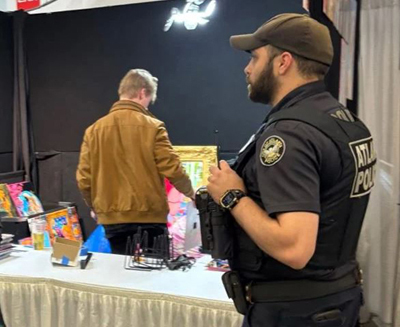
...that's what I'm talking about with the "weird combative
hostile tone" of these people. He wouldn't pack up and go until
the police showed up. Dude...You're not Rosa Parks, you're a dork
selling knock off anime posters, who lied on his artist alley
application.
Back to what I was saying...The convention that hosts that very
award show, Comic-Con International itself, has a no AI art
policy. But not the Eisner Awards themselves did not.
So, since there was no policy one way or the other, I can't blame this jerk off, nor the jerk off publisher for
submitting this...AND I'll go one step further. Seeing as how
there was no policy against it, the book should NOT have been
taken off the nomination list. Fair is f*cking fair...they
didn't break any rules. You didn't have a policy in place, that
ain't their problem.
Let them all compete, I sez. Because, if they get a nomination,
it's not an "AI art" problem, it's a worse problem.
"we weren't told it included AI art" sez the judges...Hoe lee fuq
...it doesn't matter what a policy is,
if
you don't have anyone enforcing it who can tell when someone is
obviously breaking the rules. You weren't "told", it was AI art? Oh, you dear sweet naive
people...Someone breaking the rules, ain't going to TELL YOU they
are breaking the rules.
I'm probably going to regret saying this but...this is the
judge's problem. You're job, theoretically, was to give great scrutiny over
the best works from pros at the highest level...and you couldn't
spot some AI art, that the internet called out half a cup of
coffee after it as announced as a nominee?!
I could tell it was AI art at panel one. If you were some lay
person and say, "I didn't notice. It was a long book and I
blew through it." Fine. But as a judge for the one of
the most prestigious awards in comics, if you didn't even look
at it long enough to go "what the fu..." then what are you
doing, exactly?
Letting this get past you has more people than
just me wondering how TF you are determining what gets
a nomination, if you ain't even looking at any page closely
enough to see it's obviously AI.
Just like anyone who's been around as long as me, I know a bunch
of legendary pros. You know when I hear from them? When they're
pissed off and want to vent about something. I've been hearing
from them. If this happens again, things are likely to get real
ugly.
I say this because I am rather proud of the one nomination I got
some years back and would prefer and bunch of legends not take
to the internet and deem that the Eisner awards are a worthless farce.
THE LIE
Michael Todasco (alias Alex Irons), the jerk off who made the
A.I.art page, had this to say to
Publishers Weekly-
"Todasco said he is not concerned about whether or not his
use of AI in the Stardust piece constituted a misuse of other
creators' intellectual property, since the materials on which
the AI was trained were in public domain."
"After training AI software on the original Stardust stories
by Hanks, Todasco used the results to generate both the script
and the artwork for a ne-page comic"
I'm sure when uttering that LIE passing itself off as a half
truth, he figured no one would catch it. Because you have to
know about Fletcher Hanks AND about how the AI programs work. As
luck would have it...I do. What he claimed is bullsh*t.
Fletcher Hanks came out of the
blue into the comics industry as a writer/illustrator in 1939
spent two years making some of the weirdest stuff anyone ever
saw, then left in 1941 never to be heard from again.
Fletcher Hanks only created 17 Stardust stories each about 7
pages long. And even
If you took every single story he did in his extremely
brief career, it's a body of work that's about 200 pages or so.
That is NOT, in and of itself, anywhere near enough to train an
AI program. So, what would have actually gone on here is- he
would have added Fletcher's works to a program that had already
been trained, like all the rest, on an enormous body of data
/works it scraped (stole) from other illustrators.
I don't know how best to sum up how these programs work, but it
boils down to parameters and probabilities. You feed it pictures
of a cat and it starts creating parameters. Cat=four legs, two
eyes, two ears, ect. You have to feed is a massive library of
images of cats before it stops spitting out images of something
that could be a cat, a dog, a bear, or a crime against
nature. and if the only image it has of a cat, to use for scale, is one next to a matchbox car...the parameters of a cat is that
is it 16 stories tall.
It does not think, it does not calculate via logic, it does not
understand the function of anything mechanical or biological, it does not
understand perspective, or foreshortening. If it only got
pictures of a cat from the front...it's parameters of a cat is a
head with four legs. You follow me, so far?
They needed to cull hundreds of millions of images
(copyrighted images...intellectual property)
to get it to produce the images it does at this point . So the
notion that this guy ONLY trained the AI on Fetchers works is
complete 100% horseshit.
If, at some point, he goes on to claim he meant it was trained
with other work but they were all public domain, that would also
be a lie.
There does not yet exist a bot that is so complexly coded as to
track down the history of each image it steals to make sure it
is public domain, and there is not enough public domain
material out there to train these programs. That's not my assessment,
that is directly from the mouths of the people who created the
programs.
Anyhow...for reference before we go forward into more interesting
things...here is the page that
Todasco, used
the most advance mathematical probability software available to
man, to crap out...
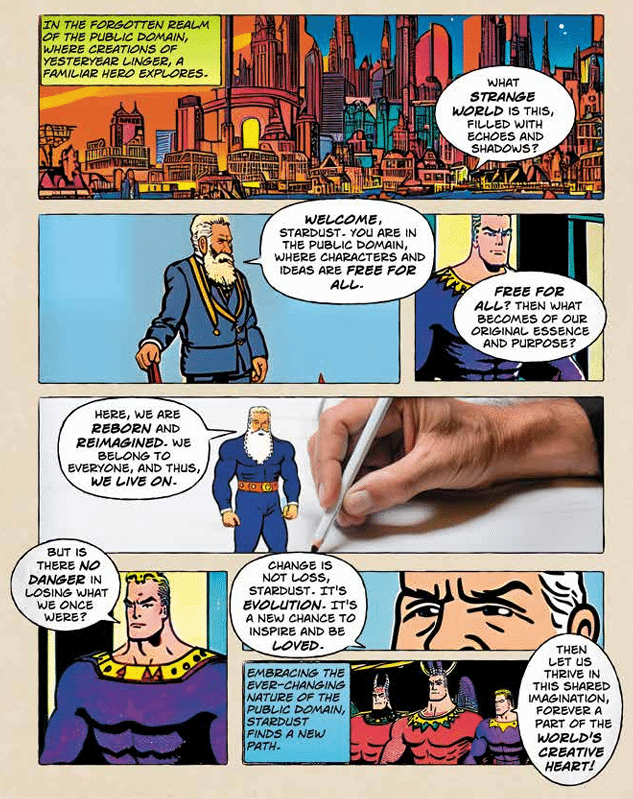
Hideous.
The phrase "a solution in search of a problem"
comes
to mind with everything we see people using AI for, and
especially in this case. We're not talking about trying to duplicate some
wild over the top style, like the late great Sam Keith, or the
precise masterful work of Barry Windsor Smith
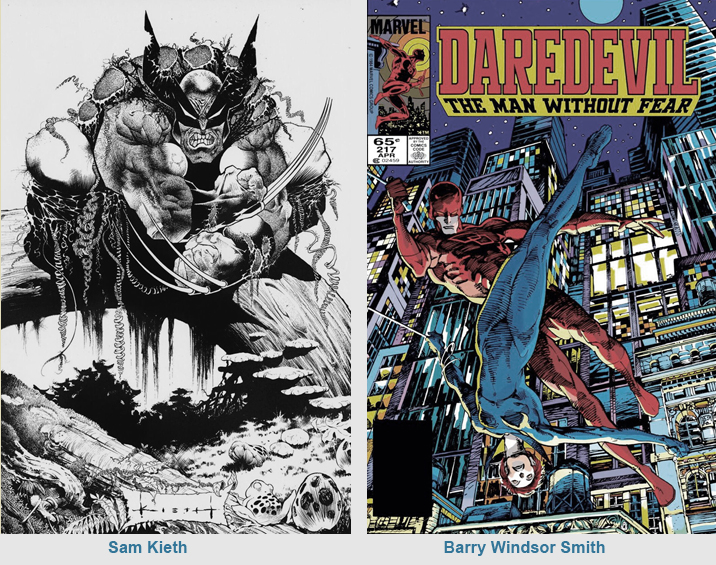
We're talking about copying Fletch Hanks. Who was...not very good. At all.
And certainly not someone with a complex, intricate style.
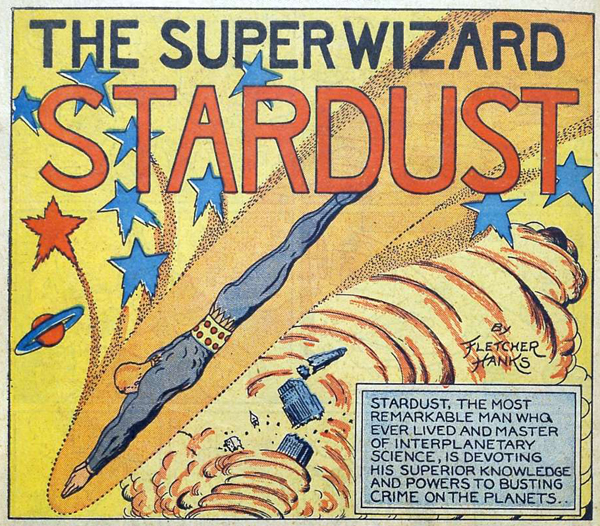
I dare say anyone with even a passing interest in drawing
would be able to mimic this guy after one afternoons practice, if
it even took that long.
Let's look at this first panel here from the
A.I.
page...which is
when I knew it was A.I.
...
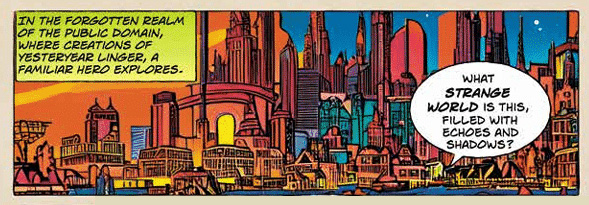
That is typical A.I.
art, in that it is a visual representation of
a city. And that's all it is. A.I.
is good at producing such images. It looks like a city,
it's got plenty of detail. It makes visual sense if you don't
look at it too long, which you won't...because it's not compelling to look at.
There is nothing interesting about it, because AI is not
interested in anything. There's nothing to focus on or capture your imagination and
nothing stands out. It's visual white noise.
It is a collection of details in the form of what the program
defines as a fantasy city.
We'll contrast that with a fantasy city drawn by Winsor McCay...
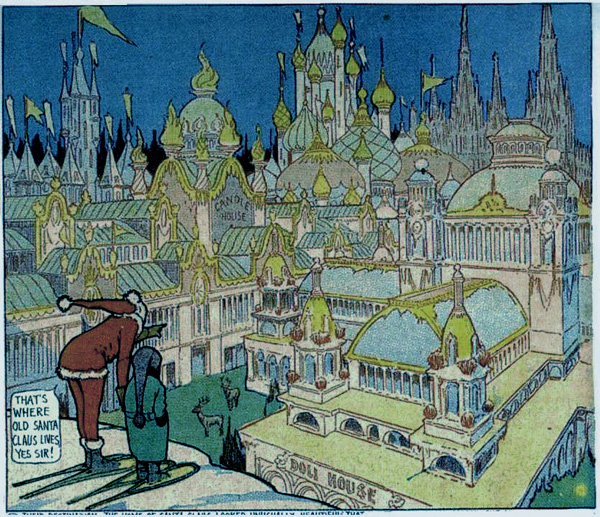
A reader could stare at this for as long as they wanted...and
let their eyes explore and imagination wander into the world in
front of it. AI is no match for a human using ink and a dip pen in 1920s.
For that matter, to compare apples to apples, here's a city
actually done by Fletcher.
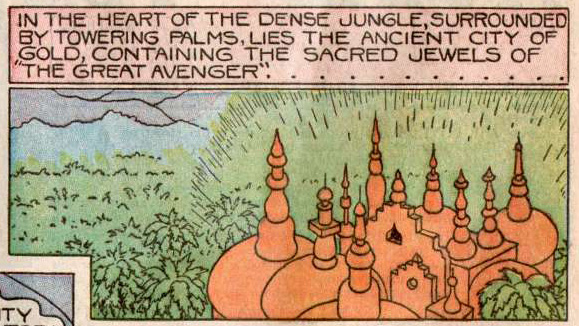
Fletcher's is crude, simple, not nearly as detailed or complex. but if feels like
you're looking at something, not just being given visual input.
It's whimsical, fun to look at.
ONTO THE REAL POINT
Onto the interesting part.
The whole mess is
possibly
a perfect example of AI art not being capable of having any of the value and impact of actual human creativity.
The anthology in question was
on the work of Fletcher Hanks from 1939-1941.
Specifically, his character Stardust
who was like an...outer space superman, but he is better known
for his character Fantoma. She is considered by most to be the
first ever female super hero. She saw print about three years
before Wonder Woman.
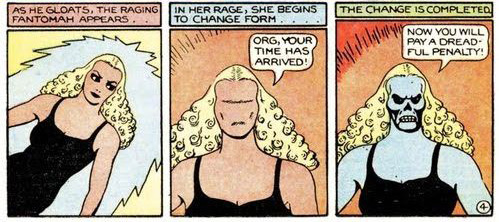
This era of comics (immediately leading up to WW2)
was...bad. It was by and large just...just garbage. It was an
era where "pros" didn't really know what they were doing, didn't
grasp the possibilities of the medium, and didn't care. Because,
the editors didn't care, because no one cared. Produce 48 pages
that can amuse a 10 year old who doesn't even know what TV is
yet. That was the job.
Many (most) illustrators where approaching telling a story in
comic book form like a child's picture book- draw an image that
matches the words.
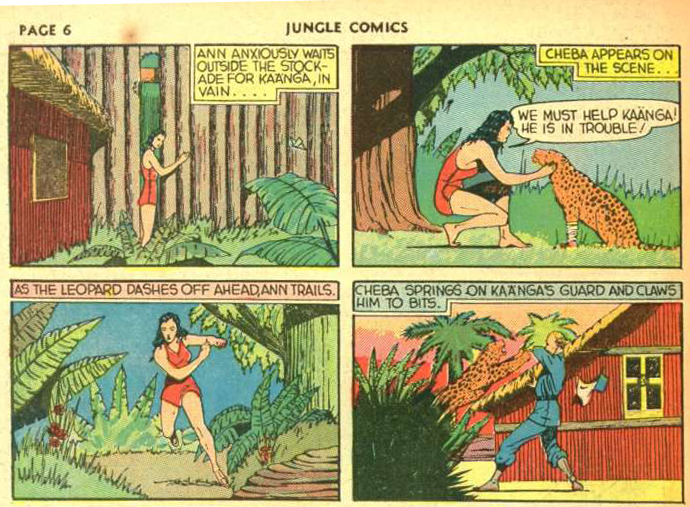
as opposed to what comic book storytelling could and would
become...
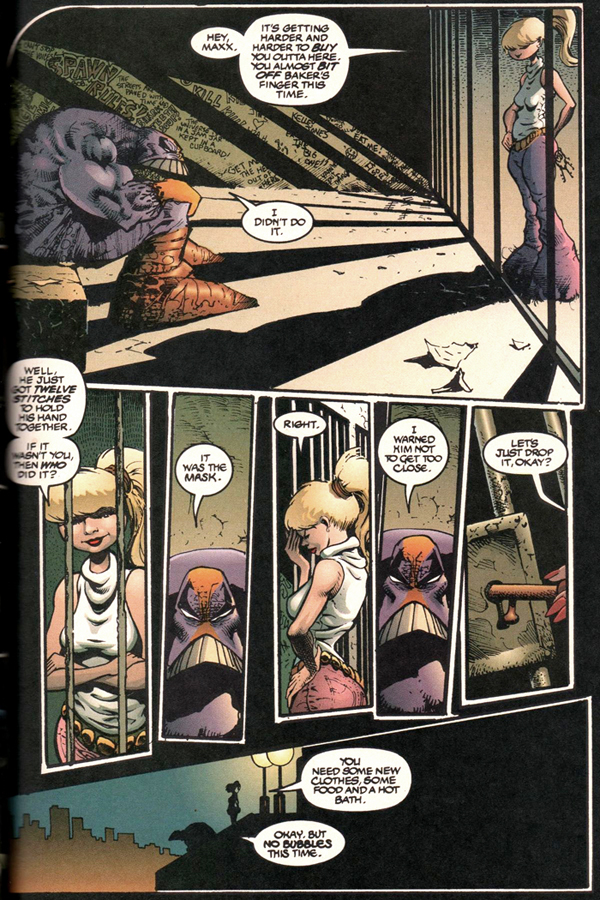
Backgrounds
were a luxury, Poses were stiff, there wasn't much of a feel of
action to the action scenes.
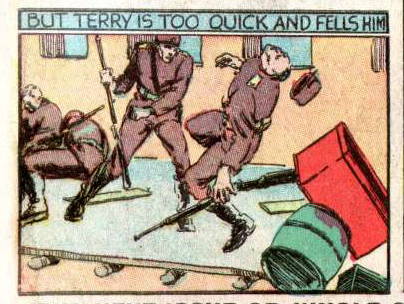
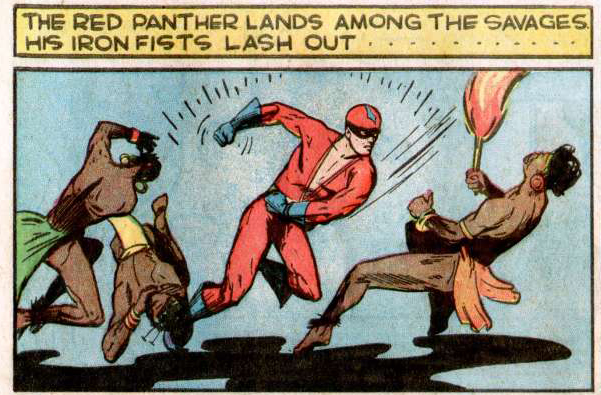
They paled in comparison to what was a "action" shot later on.
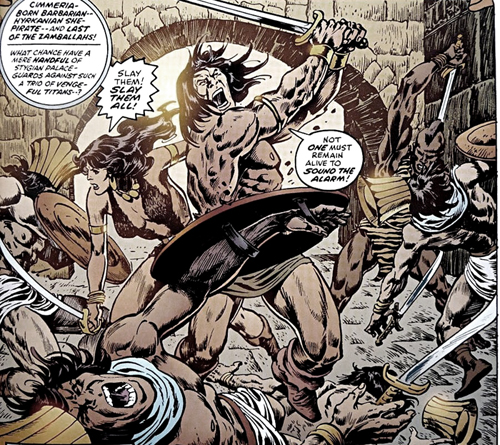
Post WW2 "the Golden age" was when things really started
advancing and competition got serious and publishers realized
that these books were being bought by adults as well as
children. So, the industry as a whole upped it's game.
The time in which Fletcher worked was, quality wise, one of the
worst eras of all comic book eras. With that in mind, and all
things being relative, he was...still not very good.
Technically.
His illustration skills were sub pare, his stories
were a random wandering mess, his compositions were awful, his visual
storytelling was bad to the point of being confusing.
(this is all leading to a larger point)
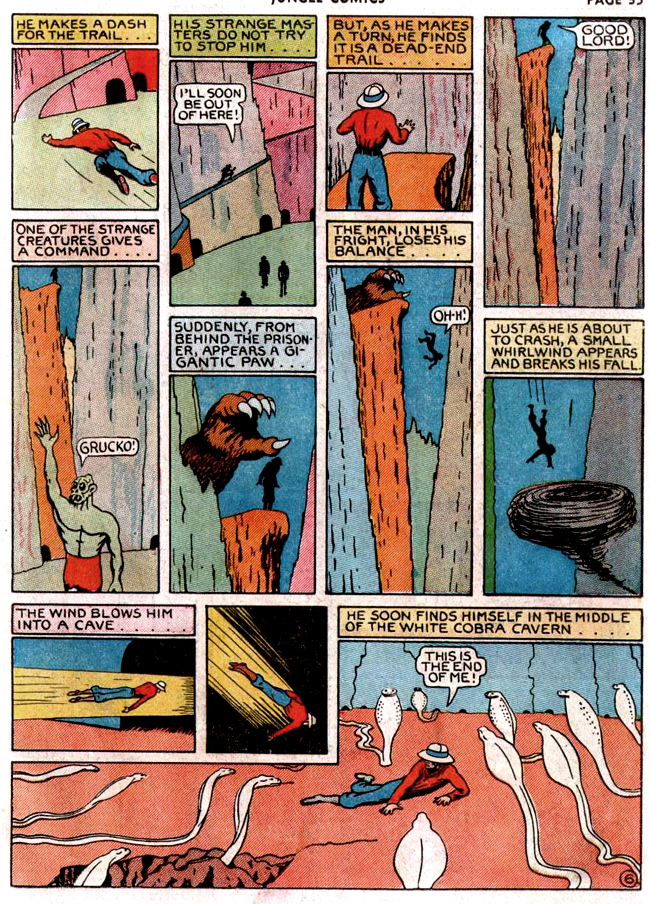
This here...this example is par
for the course of him trying to tell a story in comic book form.
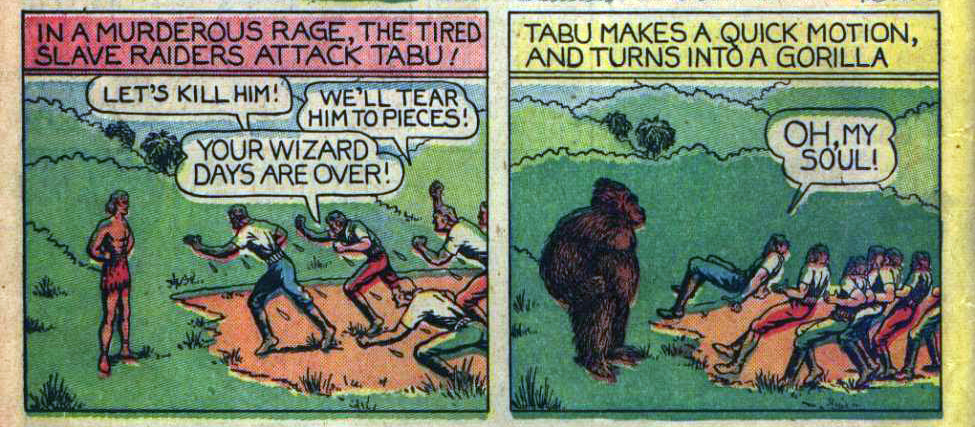
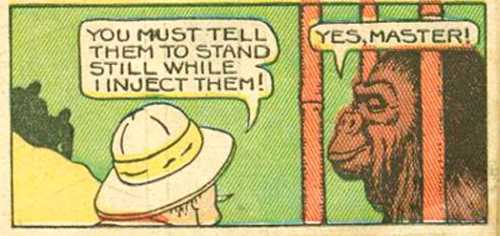
..."and then he turned into a Gorilla". I love it. In
case you are thinking "some context to this story would help".
I assure it would not. The guy seemingly just drew whatever the
f*ck popped into his head on any given panel, absent of rhythm or
reason.
It's like every three panels he forgot where he was going with
something and just says "f*ck it....then this new thing happens"
Despite of all of that, his work's been
reprinted into collections several times over the years
and was the subject of the aforementioned anthology created by
some top pros in the industry. His work has
kept and re-found an audience over and over and over for the last 80 YEARS.
There's even toys and figures of some of his stuff...
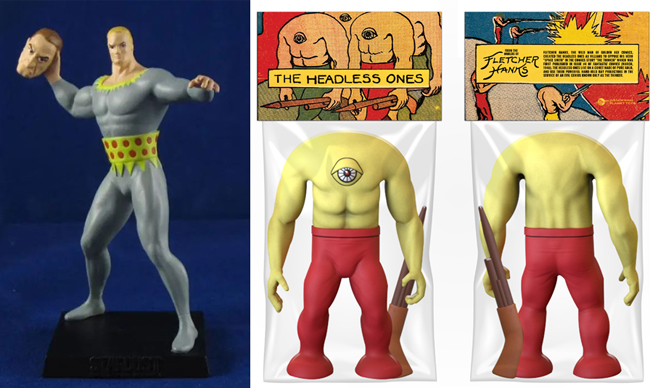
Why? hell if I know. It's more than just a "it's so bad that
it's good" situation, because just about everything at that time
was bad. His stuff just sucks people in somehow.
New people become fans of his work, all the time.
And I'm one of them, but if you pointed a gun to my head I
couldn't point out anything particularly good about any of it.
Human joy's a mystery. Why does one song catch on and other
doesn't, why does person A fall in love fall in love with person
B, how is it that John Lovitz can have me in tears laughing with
one sentence and a 45 minute set from Jerry Seinfeld is just
something I appreciate as "well crafted"? Sometimes, there's
instances where some things things just hit you and some things
just don't...and that's that.
And the whole drive of creative enterprises, is chasing the
possibility of making a thing that hits, for hopefully many
people. I'm not trying to draw a city...I'm trying to get
you to see a city. I'm not writing comedy, I'm trying to make
people laugh. The whole AI art thing misses that whole notion.
You want it to connect, to matter to someone, for someone to
understand what you are trying to convey. That supersedes
everything else, including skills you have or don't have.
The excuses I see again and again from people using AI instead of
trying to draw something themselves are "I just don't have
talent"...."I'm just not good enough" ..." I'll never get that
hang of XYZ"..." I'm not good enough at blah blah blah". Fletcher
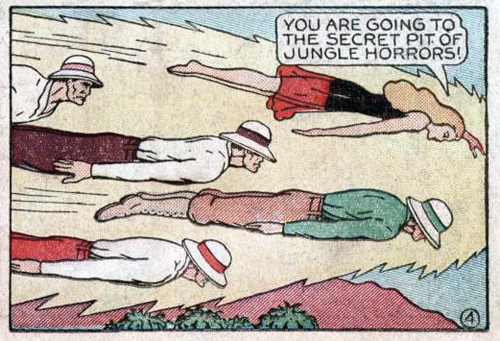
Hanks wasn't any good at any of it either. He was flat out bad at a lot of it. He just did it anyway. And lot's of people loved
it.
There's an aspect to this that anyone running to AI
instead of trying to develop the skills needs to understand.
People may think your work is good even if you don't, even if
it's "technically" not good. Most of us don't think we're as
good as other people think we are. All of us focus on the flaws
of everything we do/did. Everyone of us compare our works to
other's, unfairly. We all have imposter syndrome and are our own
worst critics. That is part of the whole deal.
I think that
many AI users either don't know that or just can't bring
themselves to accept it. They don't want to see their flaws or
show their flaws, or have ownership over flaws. Flaws are the
whole point. Flaws are the base, to be overcome, or used to your
advantage, or ignored/accepted and putting out work anyways.
There is a thin thin thin line between one's flaws and one's
creative voice. They might even be the same thing. I say all the
time that "style is just doing the same things wrong
consistently". Your work/what you do has flaws/things your
are not good at, you put in the man hours getting better, and
put in more man hours to try get better still, and some remnant of those
flaws remain part of it, through osmosis or as part of your
creative DNA. And THAT is, in part, your creative voice.
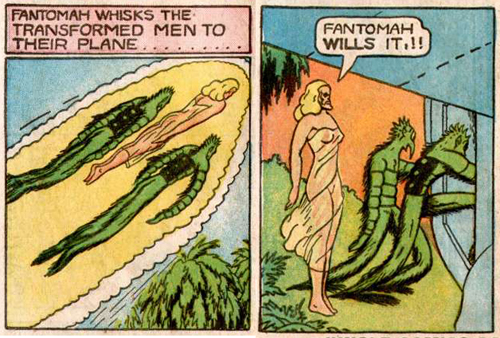
That is what Fletcher Hanks did, and his creative voice made him
legend, despite having almost no skill and clearly no plan...but
that AI art can not do, nor duplicate. Because it is not a
human. It is a mathematical probability program. Advanced, yes,
sophisticated, yes. Does it have anything to say, or a
personality or perspective grown from emotional experience,
which is an undercurrent? Does it have an urge to take an idea
and convey it to humans? no, no, and no.
A story isn't a story, a story is
someone telling you a story". That probably
sounds like something Yogi Berra would say, but try to get the
meaning. Fletcher
gets an idea in his head, and how it comes out, because of or
despite of his flaws, is the magic of it all.
.jpg)
It's all unquantifiable at a certain point. It's one
subconscious
mind communicating to other subconscious minds with their
respective conscious minds as interfaces. Is a quiver in the
singers voice conveying something neither of their conscious
minds caught? Is a wiggle in a line doing the same, via it
giving emphasis in some way we don't consciously understand?
Probably, and any non human element you put between you and your
audience neuters that.
Understand? I hope so, because everyone of you that turns to AI
instead of putting in the man hours, is one less person who will
ever put out anything great. If AI existed in 1939 and Fletcher
used it instead of just drawing the best he could and letting
the chips fall where they may...no one would have remembered his
name.
Anyways...
From everything I've told you about Fletcher, you probably have
the impression he was some obscure talent who's work eventually
developed a cult following. And even many of his fans view him
this way. A collection of his stuff
from Fantagraphics Publishing even makes this claim "Fletcher Hanks worked on second rate characters for third rate publishers".
That is not actually the case.
Fletcher was on name brand, mainstream books.
He was working for Fiction House and Fox
Publishing, which were two major publishers, at a time when
individual issues sold in the hundreds of thousands and even
millions. The books he was part of had massive sales. We're talking
millions of copies of his work being circulated over a two year
span. And his Fantoma strip was popular enough that they they
kept it going with a new creative team after he left.
I'll get back to that in a second. Let's absorb a bit more of
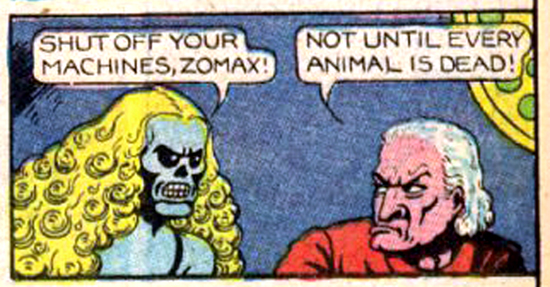
his work. Here's the end of a
Stardust story...
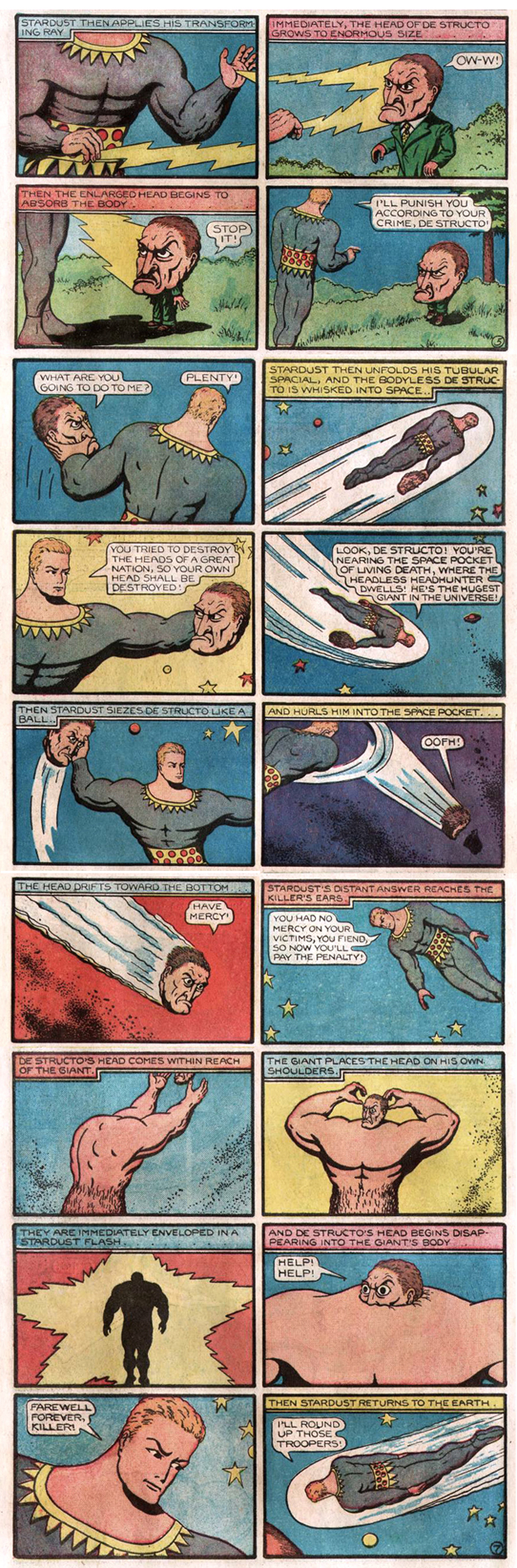
To recap, he shrinks a villain into just a head, then
throws the head at a headless monster, who absorbs the head.
He did this work when he was in his 50's, by the way. If you
recall my blog on the sweet spot in one's life to find your
creative voice...here's one of those exceptions.
...this one here's presentiment of Planet of the Apes, perhaps?
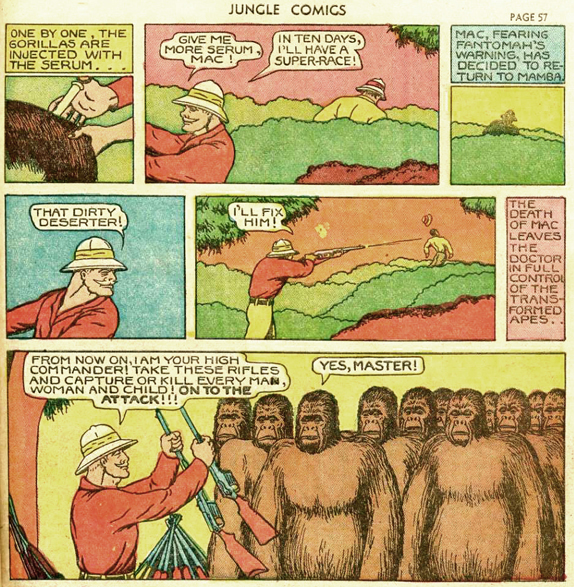
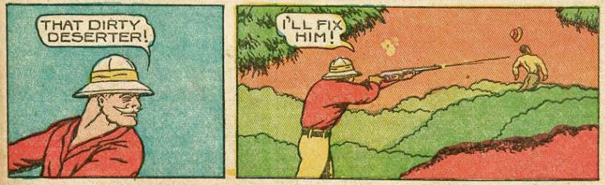
This sequence (below) cracks me up. I'm not sure if
it's the distance or the hat flying off, or the whole general
blurred line of Fletcher's worlds, where you don't know what
level of drama you're supposed to be getting out of it.
He only made 15 installments of Fantoma,
before he left the comics industry for parts unknown. After he
left a new creative team was put on a Fantoma. The quality took a big leap forward. The new stories made
sense, the illustrator was much better. The Fantoma
character finally had some legit skill working on it, to put her
over the top..
Here's some random examples...
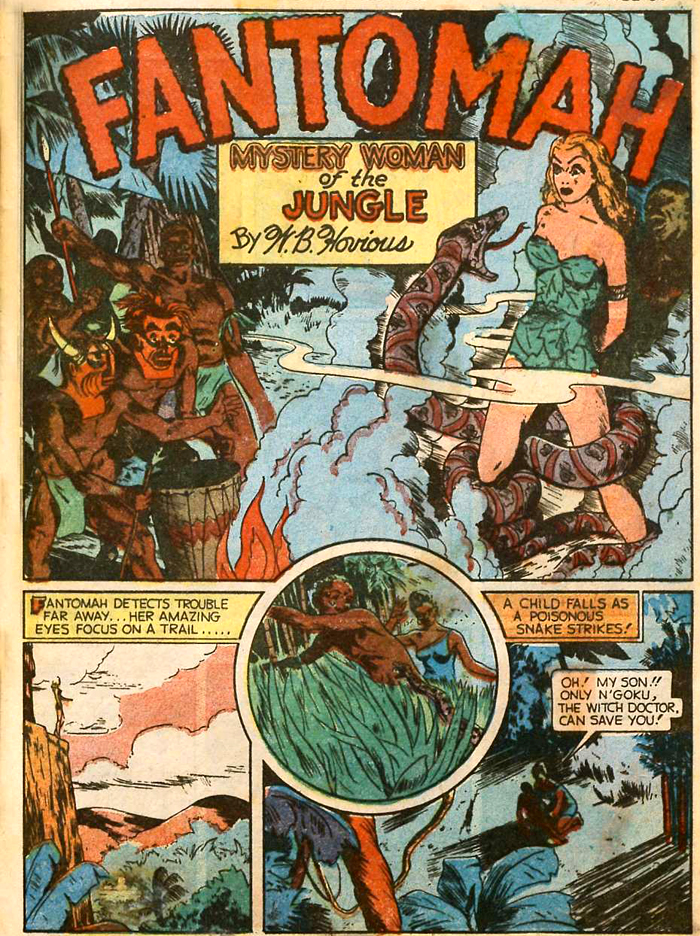
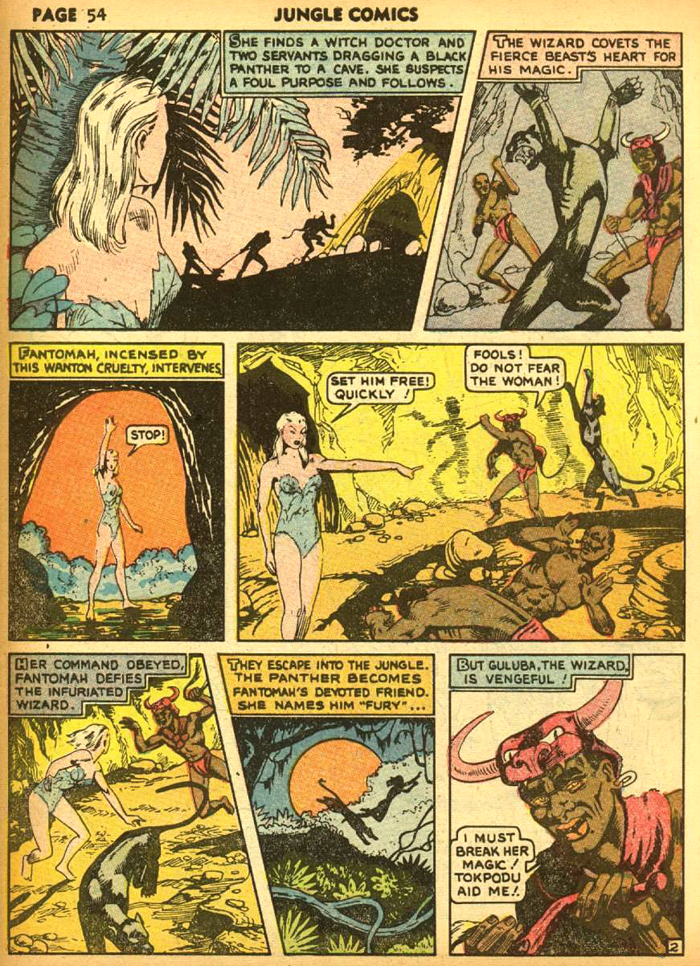
Look at that, we have continuity through the panels...details,
backgrounds, different camera angles for effect, competent
understanding of human anatomy...even some experimentation with
panel shapes!
...and guess what?!
No one gave a f*ck.
... and no one has since. No one has any interest in Fantoma
stories done after Fletcher stopped writing and drawing it. The
new team made technically better work, but it not
actually better work, because it didn't connect with anyone.
That lesson, and the entire concept of Fletcher's
works being legendary, even though he couldn't draw worth a sh*t, was lost on the
dork who used AI to mimic him. And lost on anyone who runs to AI
to fix their shortcomings.
As for Fletcher himself, and what he did before or after
comics...no one's been able to find out much. The ugly rumor is
that before comics he was an abusive alcoholic who beat his kids
and abandoned his family in 1930. I guess...if
you wanna believe his kid, then that was the case. (shrug) how
much drinking of alcohol makes you and alcoholic in the eyes of
a ten year old? He's not an alcoholic addiction specialist, just
he's a WW2 pilot who rose to the rank of captain. I guess,
if you consider him credible...
As far as leaving
his family, the great
depression just started. He looked at the situation, saw three
mouths to feed, and logic deemed only one course of action.
Sneak out the window in the middle of the night and never come back.
What he did, or what he turned into between 1930 and
1939...nobody knows. What he did from 1941 til 1976...nobody
knows.
I'm guessing the less any of us learn about him the better.
Let's just look at the kooky monsters and not think about any
gin fueled rampages he might have went on. He's been dead for
50years anyways.
In the mid 70s the NY police ran across him. He had frozen to
death, on a bench in a park, all alone. Y'know...As one
does. I often think about doing a research
book of all the golden age comic artists who met a tragic end. Jack Cole shot himself, Wally Wood shot himself, some
other guy threw himself in front of a subway car...lots of them
were alcoholics. The ratio of comic pros, from the early eras,
who had pitiful sad ends is right up there with alumni of
Saturday Night Live and Pro Wrestling. You're better off not tracking any of them down, to see how
they ended up.
Uhm...have a great weekend!
Protect your art from AI with Glaze
or
Nightshade
(make sure you use the updated versions. Because, I sh*t you
not, the AI jerk offs developed software to bypass the early
versions of this protection. Classy.)

